White Paper
SOC 2 Compliance Without the MDM Trap
A practical path to defensible SOC 2 and ISO 27001 audits across BYOD, BYOPC, contractors, developers and AI agents — with continuous device-posture evidence streaming into Vanta, no legacy MDM/UEM enrolment required.

Executive Summary
SOC 2 and ISO 27001 have become baseline expectations for any service organisation that sells to enterprise customers. Reaching them used to be largely a paperwork exercise on top of a fleet of corporate-owned laptops. In 2026, that is no longer the shape of the in-scope fleet: BYOD and BYOPC users, contractors and partners, developers with admin rights, CI/CD runners, self-hosted build hosts and now AI agents (Cursor, Claude Desktop, Claude Code, Codex, OpenClaw, Hermes) all touch the in-scope service. None of them fits the classic answer of “enrol every device in MDM/UEM.”
This paper keeps the framing simple. SOC 2 is an attestation framework on controls relevant to the Trust Services Criteria, not a device-management mandate. The auditor is not asking whether you deployed Intune or Jamf — they are asking how you control risk over the in-scope service and what evidence shows the control operated effectively. The right answer is a layered, identity-first, posture-aware control mesh, with continuous endpoint evidence streaming into Vanta. My company EDAMAME built the layer that fits exactly where legacy MDM is the wrong shape, and the EDAMAME × Vanta partnership turns that posture into live audit evidence.
The Modern Compliance Landscape
Modern engineering organisations now run on a mixed fleet that the SOC 2 auditor expects to see represented in the evidence pack. The in-scope populations widen the surface in distinct ways:
- Full-time employees on macOS, Windows and Linux, often with strong opinions about lockdown
- BYOD and BYOPC users — personal laptops and home PCs the company does not legally own
- Contractors and partners who arrive with their own hardware, ship for three months, and offboard the day the SOW ends
- Developers with admin rights, IDEs, package managers, SSH keys, PATs — plus AI agents on the same workstations
Each of those populations widens the SOC 2 surface in a different direction. Because most of them sit outside the asset-register fleet, the typical "point Intune at it" answer either does not apply or actively breaks against legal, privacy and engineering-culture realities.
This is exactly why a no-legacy-MDM SOC 2 programme needs continuous, reviewable, auditor-friendly endpoint evidence — not screenshots, not spreadsheets, not heroic quarterly assembly.
Why Legacy MDM Is the Wrong Shape
BYOD and BYOPC Cannot Be Enrolled
NIST SP 800-124r2 (2023) is explicit: classic MDM policy on a personally-owned device collides with employee privacy expectations. EDR agents on personal hardware raise the same legal and HR objections. The result is that BYOD/BYOPC populations either sit outside the asset register entirely — invisible to the auditor — or get partial coverage that the audit can immediately pick apart.
A control that the legal team will not approve, or that users will refuse to install, is not a control. The audit cannot rely on it, and the security team is reduced to a quarterly spreadsheet exercise.
Contractors Outpace MDM Rollouts
Many contractors are productive in three to five days and gone in three months. MDM enrolment timelines (provision device, ship laptop, install profile, wait for first sync) are simply not compatible with that cadence. Treating contractors as full-MDM employees adds days to onboarding and creates an offboarding tail nobody owns.
Auditors notice. "Show me the asset record, EDR coverage and access review for every contractor active during the report period" is now a standard SOC 2 Type II evidence request, and the spreadsheet-only answer is fragile.
Developers Will Fight Lockdown — and Win
When lockdown is the wrong shape, engineers work around it. They install on personal laptops. They demand admin rights and get them. They build shadow workflows the auditor never sees. The control on paper diverges sharply from the control in production.
AI agents make the divergence worse. Cursor, Claude Desktop, Claude Code, Codex, OpenClaw and Hermes expand the code and pipeline surface with shell access, file-system access and MCP-connected services. Locking the laptop down does not lock the agent down. Pretending otherwise is the kind of control gap a competent auditor finds immediately.
MDM Does Not Speak Continuous Evidence
MDM/UEM consoles are great at enforcement (push a profile, deploy an app, wipe a device). They are not designed as a continuous-evidence feed into a SOC 2 / ISO 27001 control catalogue. They produce screenshots, not the time-series posture record an auditor wants over a Type II report period.
Evidence still ends up re-assembled by hand at audit time: which devices were in scope on which dates, which were patched, which had EDR, which were jailbroken or rooted, which were retired. That is exactly the manual work continuous compliance is supposed to remove.
The SOC 2 Evidence Gap
The evidence gap shows up once the policy stack is in place. The IdP is humming, MFA is enforced, repos are protected. But the auditor still wants live answers to a different class of question: which devices touched the in-scope service this week, what was their posture at the time, and what happened when posture changed. Most of the population producing the work has no MDM record at all, and the populations that do have an MDM record produce screenshots, not a continuous stream.
- A BYOD laptop accesses the in-scope service, but no continuous posture proof exists for the report period
- A contractor finishes their SOW but their tokens, SSH keys and laptop access linger for weeks
- A developer’s personal access token works from any machine, with no evidence of which machine was actually used
- A self-hosted CI/CD runner falls out of compliance while builds keep deploying to production
- An AI agent runs on a drifted host, with no evidence the host was still compliant when the agent acted
The EDAMAME × Vanta Live-Evidence Loop
My company EDAMAME and Vanta close that evidence gap together — a partnership we have been quietly proving in production for over a year, now official in the Vanta Marketplace. The shape is intentionally simple:
- EDAMAME Security — workstation trust anchor for employees, BYOD and BYOPC users, and contractor laptops on macOS, Windows and Linux
- EDAMAME Posture — CLI and host-control surface for CI/CD runners, self-hosted build hosts, and AI-agent hosts
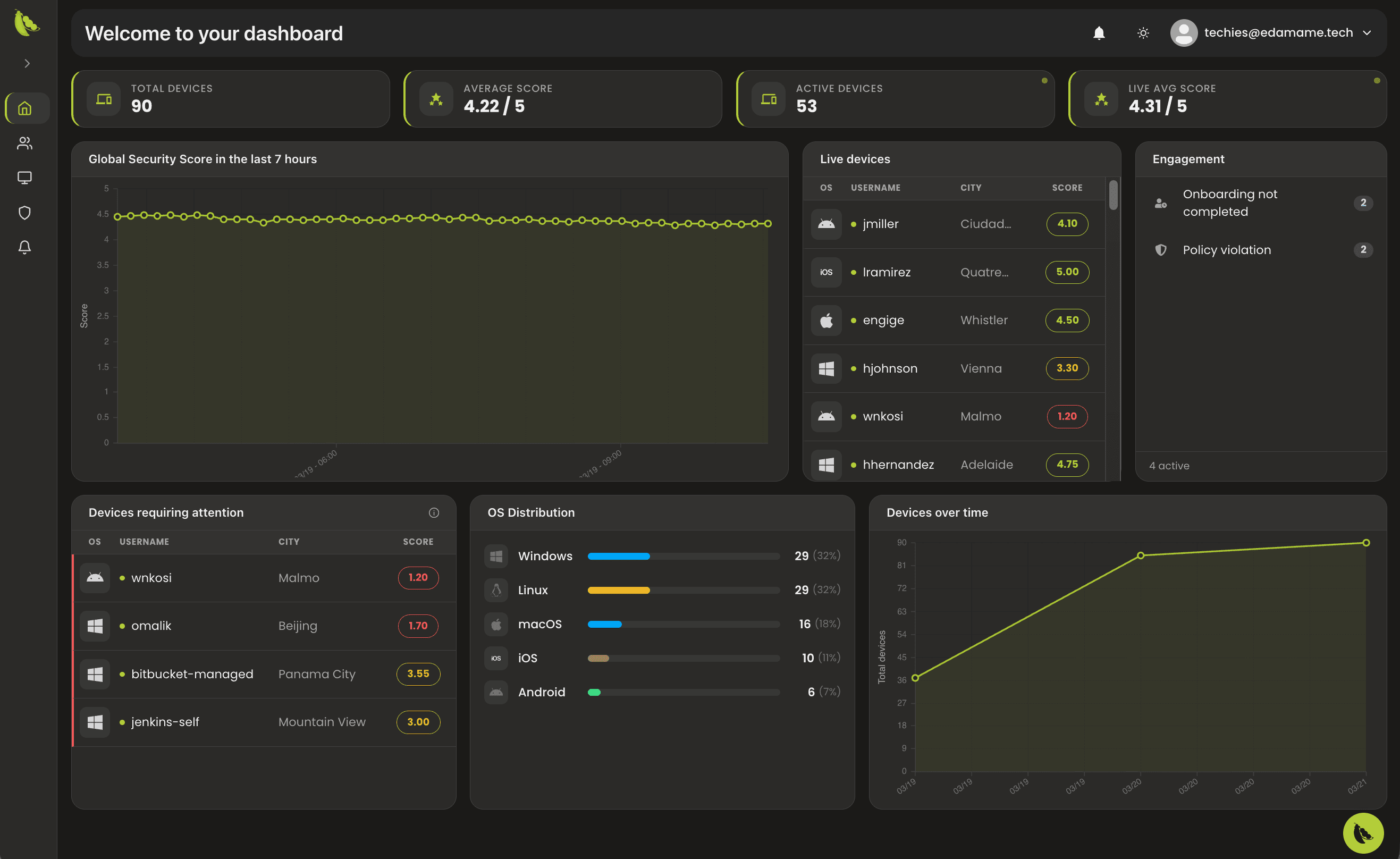
- EDAMAME Hub — fleet inventory, posture aggregation, and the bridge that turns endpoint reality into Vanta-native evidence
- Vanta Device Monitoring API — continuous device-posture attestations for macOS and Windows machines flow straight into the auditor’s report pack, alongside Vanta’s usual policy, vendor and code-of-conduct evidence; runner, Linux and AI-agent evidence stays in EDAMAME Hub
- Reporting-only architecture — no remote wipe, no covert changes, no MDM enrolment; works on personal hardware without requiring company ownership
- One trust layer, one evidence pack — across employees, BYOD/BYOPC, contractors, developers and the AI-agent hosts they run on top
This is not another MDM in disguise. It is a way to bring continuous device-posture evidence into a SOC 2 / ISO 27001 programme without forcing every BYOD user, contractor or developer into a legal-fight enrolment flow they will refuse.
Mapping the Trust Services Criteria to the Modern Fleet
Each in-scope population maps to specific Trust Services Criteria conversations (CC6 Logical and Physical Access, CC7 System Operations, CC8 Change Management, CC9 Risk Mitigation; plus Confidentiality, Privacy and Availability where the service makes them relevant). The same control mesh has to answer them all without forcing the auditor to pivot between three different evidence stories.
With EDAMAME × Vanta:
- BYOD / BYOPC employees — gate access on identity + posture at the IdP, VPN and repo layer; export continuous attestations as Type II evidence
- Contractors — same posture model plus faster joiner-mover-leaver; no MDM enrolment, no privacy debate, no offboarding tail
- Developers and AI-agent hosts — repo-side enforcement plus device posture in Vanta, with runtime verification and the agent surface (Cursor, Claude Code, Codex, OpenClaw, Hermes) kept as evidence in EDAMAME Hub; the agents become part of the audit story, not an exception to it
The result is one continuous evidence stream into Vanta — covering SOC 2 CC6–CC9 plus Confidentiality and Privacy where the service makes them relevant, and ISO 27001:2022 Annex A on the same posture data.
Real-World Audit Scenarios — and What the Auditor Actually Sees
Scenario 1: BYOD Laptop Accessing Production Data
Without EDAMAME: the employee’s personal laptop authenticates via SSO and pulls production data. The auditor asks for the device-posture record over the Type II report period. There is none — the laptop is not in MDM and never was.
With EDAMAME × Vanta: continuous posture from the personal laptop streams into Vanta’s Device Monitoring API. When posture degrades, access is revoked at the IdP/VPN/repo layer in real time, the event is logged, and Vanta carries the evidence into the Type II report — with no remote wipe, no profile install, no privacy fight.
Scenario 2: Contractor Offboarding
Without EDAMAME: a contractor finishes their SOW, but the tokens, SSH keys and shared-drive access linger for weeks. The auditor finds the gap during the next access review.
With EDAMAME × Vanta: when the contractor’s device drops out of the trust set, identity-side access and repo-side access both lose their posture proof. Vanta records the cutover event as continuous JML evidence — without ever having owned the contractor’s laptop.
Scenario 3: AI Agent on a Drifted Host
Without EDAMAME: a developer’s AI agent — Cursor, Claude Code or Codex — runs on a workstation whose disk encryption silently failed and whose EDR agent stopped reporting weeks ago. The agent commits and pushes anyway. The audit pack has no proof either way.
With EDAMAME × Vanta: posture drift on the host is captured continuously, repo access is conditioned on the posture proof, the agent surface is part of the inventory in EDAMAME Hub, and Vanta carries the timeline straight into the Type II evidence — with the AI agent treated as just another in-scope actor.
These scenarios show the difference between a policy answer and a live-evidence answer to the same audit question. SOC 2 Type II rewards the second.
From MDM Thinking to Modern Compliance Evidence
Legacy MDM/UEM was designed for a world of company-owned hardware, predictable lifecycles, and an audit pack assembled by hand once a year. Modern audit-ready engineering is different: remote work, BYOD, BYOPC, contractor cycles, self-hosted CI/CD, AI agents — all in continuous attestation. The control mesh has to:
- Keep strong audit expectations without forcing every BYOD or contractor user into an enrolment flow they will refuse
- Apply one evidence model across employees, contractors, developers, CI/CD runners and AI-agent hosts
- Support hybrid reality: corporate laptops, BYOD, BYOPC, contractor hardware, self-hosted runners, AI-agent hosts — one trust layer, four populations
- Carry the same posture evidence into Vanta — one Marketplace integration, one report pack, one auditor conversation
Governance, Audit Readiness, and Operational Confidence
Auditors need more than a snapshot — they need continuous evidence that holds across the Type II report period. Enterprise customers running deeper security reviews on top of SOC 2 ask the same questions, often harder ones. Both audiences want to see that posture is real on every device that touches the in-scope service, not just on the corporate-owned ones.
- Continuous device-posture evidence into Vanta for SOC 2 and ISO 27001
- Live answer to the "which devices touch sensitive systems right now?" review question
- Posture-conditional access at the IdP, VPN and repo layer when policy requires it
This matters for the formal SOC 2 audit, but it matters even more for the deeper security-review questions enterprise customers now routinely ask on top of the report — the ones where a clean Type II opinion is the entry ticket, not the finish line.
Implementation and Deployment Overview
- Start with EDAMAME Security on the workstations that touch the in-scope service — employees, BYOD, BYOPC and contractors on macOS, Windows and Linux
- Use EDAMAME Posture on CI/CD runners, self-hosted build hosts and AI-agent hosts
- Connect Vanta from EDAMAME Hub → Settings → Integrations (or from the Vanta Marketplace) — handshake in minutes, no custom plumbing
- Define posture and policy thresholds that match the in-scope service and the populations that touch it
- Use EDAMAME Hub to inventory unmanaged AI-agent installs, review BYOD and contractor coverage, and watch live evidence flow into Vanta for the report period
- Expand from one population to another without rebuilding the trust layer or re-justifying it to the auditor
The important point is simplicity: one trust layer, one evidence pack, one auditor conversation — even as the in-scope fleet keeps changing shape.
The Strategic Advantage: Compliance + Speed + Trust
Organisations do not want to choose between audit-readiness and developer speed. They want a model that respects modern workflows — BYOD, BYOPC, contractor cycles, developer admin rights, AI agents — while giving the security and compliance teams better evidence than they have today.
- Productivity from developer-first and BYOD-friendly workflows that engineering will actually accept
- More trust because posture evidence is continuous, not a quarterly point-in-time spreadsheet
- Lower friction than a full MDM/UEM rollout — and politically defensible across legal, HR and engineering culture
- One evidence language across SOC 2, ISO 27001 and the deeper enterprise-review questions on top of them
In short: the EDAMAME × Vanta live-evidence loop lets engineering organisations defend their SOC 2 audit without dragging contractors and BYOD users into an enrolment flow they will refuse — and without leaving the AI-agent surface outside the audit story.
Conclusion and Call to Action
The fleet that matters for SOC 2 in 2026 is mixed: full-time employees, BYOD/BYOPC users, contractors, developers with admin rights, CI/CD runners, self-hosted build hosts and AI-agent hosts. Each population widens the in-scope surface in a different direction, and none of them fits the classic legacy-MDM answer.
The practical path forward is not to enrol every device in MDM. It is to build a layered, identity-first, posture-aware control mesh, then stream continuous endpoint evidence into Vanta so the SOC 2 / ISO 27001 audit conversation — and the deeper enterprise-review conversation on top of it — stays grounded in live reality rather than quarterly screenshots.
With EDAMAME × Vanta, teams answer the SOC 2 audit, the deeper customer security review, and the BYOD / BYOPC / contractor / AI-agent reality with one continuous evidence stream. No legacy MDM/UEM, no privacy fight, no offboarding tail — just live posture, flowing into the Vanta report pack, across every population that actually touches the in-scope service.