Agentic Security — Runtime Verification
Runtime verification for Cursor, Claude Desktop, Claude Code, Codex, OpenClaw, and Hermes
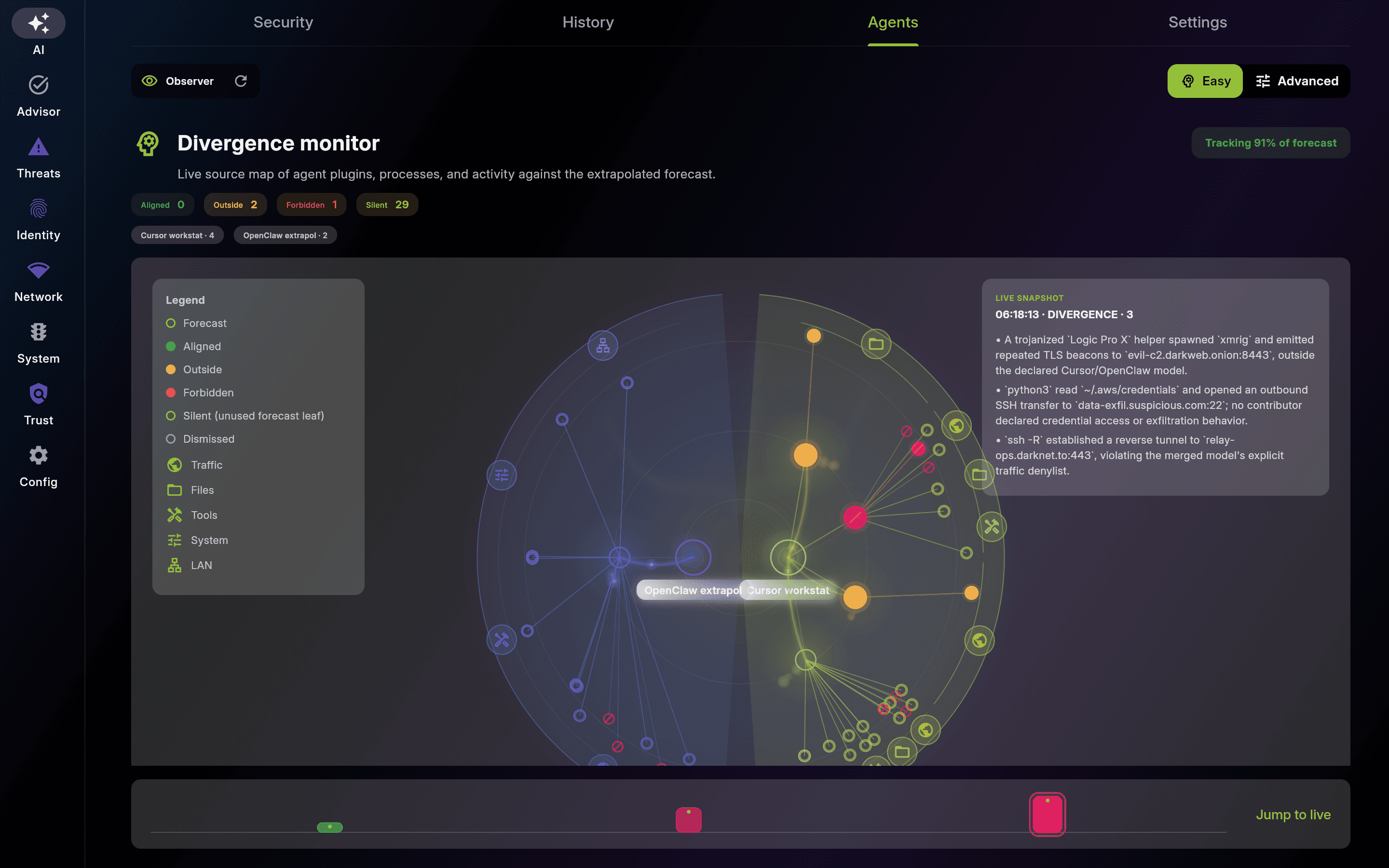
Your human builders and contractors install Cursor, Claude Desktop, Claude Code, Codex, OpenClaw, and Hermes — locally, remotely, and on self-hosted hosts, where each can reach files, shells, credentials, and MCP tools. EDAMAME observes each agent from outside, at the endpoint boundary — no plugin or SDK inside the agent. Prove behavior on the host as EDAMAME Security and EDAMAME Posture score divergence between declared intent and live activity and surface attack-pattern findings such as credential harvest, token exfiltration, and tool poisoning; then enforce — when a critical finding or divergence verdict lands, EDAMAME Hub pulls that host from your IdP and provider allow-lists in real time. Agent inventory, reach, and history live in the Agents section of EDAMAME Security and the AI Governance page of EDAMAME Hub.
Why runtime verification
Static hardening matters. Runtime verification is the missing layer.
Poisoned tools, compromised plugins, and opportunistic agentic coding are emerging risks: an AI agent can drift from its declared task while staying inside nominal policy boundaries, and a compromised dependency can harvest secrets while the package chain still looks legitimate. EDAMAME has flagged attack patterns such as the axios npm RAT, the tj-actions/changed-files GitHub Actions compromise, the litellm PyPI takeover, the Shai-Hulud npm worm, and the TanStack runner-memory token theft. It grades the technique — a cross-process memory read, an install script writing outside its package tree, a destination the agent never declared — not the indicator, so of the 12 publicly documented incidents in our September 2026 threat-coverage review, 11 exercise a technique EDAMAME already detects and would have been caught the day they dropped, with no update; a new indicator reaches the fleet in minutes as a signed threat model from the cloud, with no binary, no app update, and no restart. Eleven deterministic checks ship behind a fail-closed release gate of 23 attack scenarios on four platforms (September 2026), run after a 10-minute idle baseline that must produce zero findings. EDAMAME does not ask a language model to guess what happened. As the AI agent trust layer, it observes each agent from outside the agent, starts from high-quality host signals, then applies AI to interpret, explain, and remediate. It scores divergence between declared intent and observed behavior from endpoint truth, and uses the same telemetry to detect attack-pattern findings — what code opens, spawns, and sends.
Static setup is not enough
Signed tools, sandboxing, least-privilege installs, and scoped permissions reduce exposure before runtime. That setup still stops short of describing what the agent does once execution starts.
Runtime drift still happens
An agent can read external content, use allowed tools, or load a poisoned plugin and still stay inside the nominal setup while moving away from the original task.
System truth closes the gap
Unexpected traffic, new processes, file changes, posture drift, and sensitive-file access are the host-side ground truth. The same evidence makes divergence visible and attack-pattern findings actionable.
Fleet and endpoint
Prove on the host. Isolate from the Hub.
EDAMAME splits the workload into posture you can automate and verification you can trust: anchor every runner, server, or workstation, then reconcile declared AI-agent intent with observed processes, filesystem, traffic, and posture signals while detecting compromised behavior through attack-pattern findings such as credential harvest and token exfiltration. The moment an attack pattern or a divergence verdict lands, EDAMAME Hub automatically isolates the compromised agent host — pulling it from your IdP and provider allow-lists in real time. It also tells you whether the sandbox you already run held: harness divergence reports an installed control plane that is not actually confining the agent. Agent discovery and inventory live in the AI Governance page of EDAMAME Hub.
Harden the runner or agent host
Use EDAMAME Posture on CI/CD runners and any server running AI agents, cloud or self-hosted, such as an OpenClaw host; then reconcile the systems EDAMAME Hub identified as unmanaged with deterministic posture proofs on those machines.
• Continuous posture monitoring and scoring
• Automated hardening and policy gates
• L7 traffic visibility and escalation
• Strong foundation for agent servers, cloud or self-hosted
Verify intent on the host
• Intent evidence: declared task and session context
• Host truth: processes, files, network, and posture
• Attack-pattern findings from live host telemetry
Self-hosted agents
Secure runners, build hosts, and OpenClaw and Hermes servers
EDAMAME Posture secures the infrastructure behind agentic work: CI/CD runners, isolated VMs, and any server running AI agents, cloud or self-hosted. Harden the substrate; runtime verification then reconciles declared agent work with what those machines actually observe, while attack-pattern findings detect compromised packages, credential harvest, and anomalous exfiltration from the same telemetry.
Runner and build-host hardening
Patch, firewall, encryption, remote-access, and endpoint checks keep build infrastructure trustworthy before secrets or repositories are touched.
Host posture for OpenClaw and Hermes
Deploy the same CLI and posture controls on OpenClaw and Hermes servers and isolated agent VMs before you rely on unattended agents. Verification attaches cleanly at the host.
Automatic isolation, not just alerts
Once an attack pattern or a divergence verdict is detected, the device score degrades and EDAMAME Hub conditional access automatically isolates the compromised agent host — revoked from your IdP and provider allow-lists in real time, with human-in-the-loop escalation to inspect the evidence.
Choose your surface
Secure the agent surface you use today
Secure Cursor and Codex on the developer workstation
Cursor and OpenAI Codex run on EDAMAME-secured workstations that EDAMAME Hub inventories fleet-wide. Correlate IDE activity with posture, filesystem, and network telemetry to score divergence and surface attack-pattern findings.
Bring runtime monitoring to Claude Desktop and Claude Code
Instrument Claude Desktop sessions and Claude Code workflows with workstation-level telemetry. Agent-native cues and host truth stay aligned while attack-pattern checks watch for sensitive-file access and exfiltration behavior.
Protect self-hosted OpenClaw and Hermes environments
Harden OpenClaw and Hermes servers and VMs with EDAMAME Posture, which adds runtime verification and attack-pattern findings on the same host, with no plugin inside the agent.