Zero Trust
Zero Trust for AI agents and critical resources
AI agents are non-human actors moving across your identity, network, data, cloud and operations — a new trust boundary, crossed at machine speed. Zero Trust was built for humans at login. EDAMAME, the AI agent trust layer, extends it to the agents and the machines they run on: access follows proven posture and verified runtime behavior, not a token alone.






Who owns the agent trust boundary?
Agents do not respect the org chart. Identity owns a slice. Network owns a slice. Application, data, cloud, security and operations own the rest — and none of them owns the whole boundary. EDAMAME is one place to see and prove all of it, so it does not fall between teams.
Three questions, continuously.
Every organization has to answer three questions about every AI agent, over and over. A policy alone cannot answer the third: the agent is non-deterministic, so its declared plan is not proof — only host-grounded observed behavior shows what it actually did.
Who is the agent?
Hub inventories every AI agent and the host it runs on, managed or unmanaged.
What is it allowed to do?
Policy lives in Hub. Your IdP, SSE, VPN and repos enforce it.
Is it still acting on human intent?
Runtime verification scores divergence from host telemetry collected outside the agent.
Hub decides. Your stack enforces.
EDAMAME watches from the host — passive, monitor-only, never in the path of a request. Posture and runtime evidence roll up to EDAMAME Hub, which holds the access policy as the source of truth. When a device or an agent falls out of policy, Hub tells the access control you already run — IdP, SSE, VPN, repo, firewall — to enable or disable it. Nothing new sits between your humans and their work.
Integrations
Identity

Network
More than ZTNA, MDM, or an allow-list.
Your identity and ZTNA stack governs who may get access. MDM administers company-owned devices. Neither can tell you whether the machine behind a valid token is still trustworthy, or whether the agent on it is still doing what a human asked. EDAMAME proves that — on managed and unmanaged hosts, without MDM — and hands the verdict to the enforcement point you already own.
Identity and ZTNA
They govern who may get access. EDAMAME proves the machine is still trustworthy.
Device management
MDM administers company hardware. EDAMAME covers BYOD, contractor and agent hosts.
EDR and sandboxes
They protect the endpoint. EDAMAME watches what the agent does across the whole host.
“In the first six months of 2026, the share of AiTM phishing and token theft attacks more than doubled.”
The share is “still comparatively small”, but “it shows the direction of travel.” Microsoft also asks for revocation latency to be measured “across identity, posture, and threat protection controls”. Source: Microsoft Digital Defense Report 2026, pp. 24, 64.
How access follows posture
- The device reports its posture.
- EDAMAME Hub evaluates your policy.
- EDAMAME updates one setting in the provider: an IP allow list, a named location, an access level, a group, a device authorization or a device tag.
- The provider enforces the change on new requests.
| Integration | What EDAMAME updates | Device identified by | What the provider enforces | Worth knowing |
|---|---|---|---|---|
| GitHub Enterprise Cloud | The organization IP allow list, rewritten to the public IPs of compliant devices | Public IP | GitHub refuses web, API and Git requests, tokens and SSH keys included, from addresses not on the list | Machines behind one public IP share one entry. GitHub notes that, due to caching, adding or removing addresses can take a few minutes to take effect. GitHub Actions needs self-hosted runners, or larger runners with static IP ranges. |
| GitLab Premium / Ultimate | The top-level group's IP allow list, rewritten to the public IPs of compliant devices | Public IP | GitLab restricts the group's UI, API and Git operations to those addresses | Machines behind one public IP share one entry. GitLab documents exceptions, including GitLab Pages, runner registration and administrators. |
| Microsoft Entra ID | A trusted named location used by your Conditional Access policy | Public IP | Your Conditional Access policy grants access only from that named location | Machines behind one public IP share one entry; behind an IPv6 router, each device is matched on its own address. Existing sessions follow Microsoft's token and session rules. Needs Conditional Access licensing. |
| Google Cloud Identity | The IP subnets of a Context-Aware Access level | Public IP | Apps governed by that access level admit only those addresses | Machines behind one public IP share one entry; behind an IPv6 router, each device is matched on its own address. Existing sessions follow Google's session rules. |
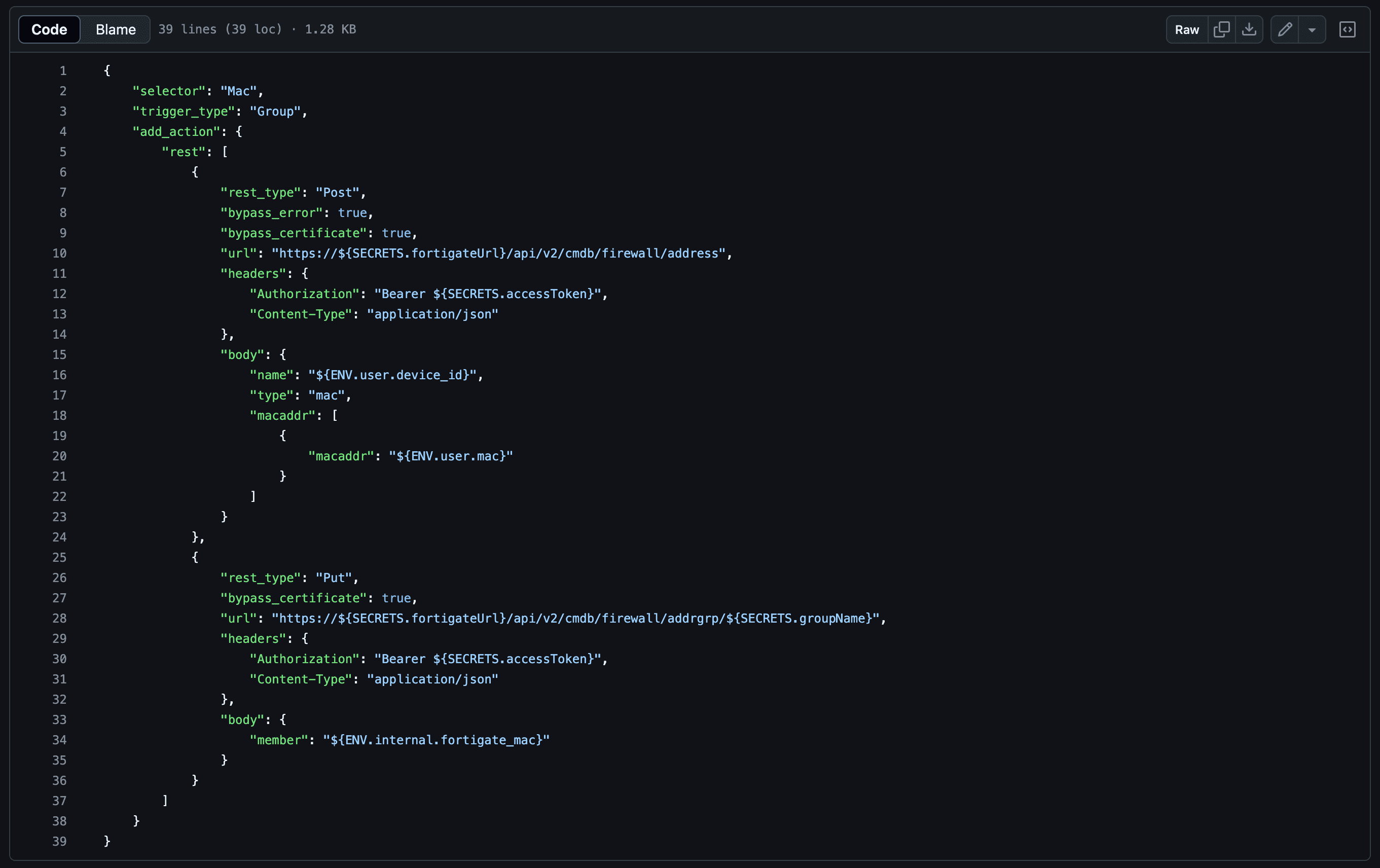
| Fortinet FortiGate | An address group of compliant devices | MAC address | Your firewall rules grant what membership allows | Works on a Layer 2 segment the FortiGate sees directly. Mobile devices report no MAC address. A randomized MAC address is picked up at the next report, a few minutes later. |
| Tailscale | Device authorization across the tailnet: compliant devices authorized, the others deauthorized | Tailscale node ID | Tailscale admits only authorized devices to the tailnet | Needs the Tailscale client and EDAMAME with elevated rights. A device EDAMAME cannot identify is deauthorized. An expired API token freezes the last state; it never opens the tailnet. |
| NetBird | The membership of a NetBird group you create | NetBird peer ID | Your NetBird access policies grant what the group can reach | Needs the NetBird client and EDAMAME with elevated rights. A device EDAMAME cannot identify is left out of the group. |
| Netskope | One device tag, applied or removed on the device whose compliance changed | Netskope device identity | Your Device Classification and Real-time Policy decide what the tag permits | Needs the Netskope Client and EDAMAME with elevated rights. Tags set by other tools are kept. An expired API token freezes the last state. |
GitHub, GitLab, Entra ID and Google trust a network address, not a single device. For a decision bound to each device, use Tailscale, NetBird, Netskope or FortiGate. Existing sessions and provider-side caching follow each provider's own rules.