White Paper
The AI agent trust layer — governance and runtime verification for every AI agent
Endpoint-native governance and runtime verification for Cursor, Claude Desktop, Claude Code, Codex, Hermes, and OpenClaw: EDAMAME observes each agent from outside, at the endpoint boundary, and proves trust from both security posture and runtime behavior. Part 1 covers AI governance — discover every agent from outside the agent, audit every check in the frameworks your auditors use, and approve each new agent, MCP server or tool as a specific exception, never by switching off the check. Part 2 covers Agentic Security — three-plane runtime verification, attack-pattern findings, and a response that goes through the Zero Trust layer you already run.
Executive Summary
Software is increasingly written, refactored, and shipped by autonomous AI agents — and increasingly by self-improving ones. Across software delivery, the principal taking action is no longer only a human at a keyboard: it is an agent that reads code, runs shell commands, installs packages, reaches for credentials, and calls other agents — often on workstations, runners, and self-hosted hosts nobody is actively watching. Security has always had to follow the principal to wherever it acts; this is the moment it must follow software delivery’s newest one.
This paper argues for governance and runtime verification of AI agents — an endpoint-native trust layer for the AI agent. The instinct is not new: EDR brought detection and response to the endpoint, and XDR correlated it across endpoint, network, and identity. EDAMAME carries that same instinct to software delivery’s newest principal — the autonomous, increasingly self-improving agent — a complement to EDR/XDR and the SOC, never a replacement. Its thesis is a vantage point: the endpoint boundary, where an agent’s intentions become real processes, files, sockets, and secret access, is the one place an agent can be observed from outside itself, on an evidence trail it cannot rewrite — with no plugin or SDK inside the agent. Hardening stays the precondition; from there EDAMAME runs the loop — discover every agent and what it can reach, audit each check in the frameworks auditors already use, approve what may exist as specific exceptions, prove what happened from host-observable evidence, and respond when behavior diverges from what the human authorized and the agent declared, or when attack patterns appear. Trust is established from both the host’s security posture and the agent’s runtime behavior. The paper is organized around the two parts of that loop: Part 1 — AI Governance, the deterministic, no-LLM discovery of every agent, its tools, and its reach, audited in the frameworks’ own words and governed through specific exceptions; and Part 2 — Agentic Security, the verdict layer that scores divergence across three planes, detects attack patterns, and contains a compromised agent host through conditional access.
The AI-Agent Risk Landscape
Modern agent workflows collapse several sensitive capabilities into one loop: read repositories, call tools, modify files, use network access, install packages, and touch credentials. Common risk patterns include:
- Hidden instructions in issues, docs, or chat that change future tool calls
- Malicious plugins, MCP servers, or package dependencies that reshape agent behavior
- Exfiltration of tokens, SSH keys, CI secrets, source code, or developer wallet material
- Posture drift on the host while the agent keeps working
Because agents operate with valid local context and legitimate tools, many failures do not immediately look like classic malware. The system may appear to be working normally while risk quietly increases.
This is exactly why AI-agent security needs discovery, audit, and runtime verification from outside the agent, not just stronger setup checklists.
Why Traditional Controls Fall Short
Supply-Chain and Setup Controls
Signed artifacts, dependency review, sandbox posture, guarded tool integrations, and conservative tool scopes still matter. They reduce accidental exposure before the agent loop runs fast.
But once an agent is running, those controls do not fully explain whether its observed behavior still matches the declared task. Setup quality reduces risk. It does not eliminate runtime drift.
Identity and Login-Time Trust
Identity systems do a good job at authenticating the user and establishing a trusted session. Device checks at sign-in can also improve the starting point.
The weakness is persistence. A workstation or server can change after login, and agent work can continue through tokens, SSH keys, or already-approved tooling. Login-time trust is not the same as continuous runtime trust.
Sandboxes, Tool Scopes, and Policy Hardening
Restricting tools and limiting privileges are essential for safe deployment. Narrow scopes reduce blast radius and make abuse harder.
Yet even a well-scoped agent can still perform undeclared behavior inside its allowed surface: unexpected egress, suspicious file access, risky package installation, or posture degradation on the host. Policy hardening helps, but it does not create runtime truth on its own — and a sandbox that was disabled, a deny rule that was removed, or a denied command re-spelled until it succeeds is exactly what an outside observer has to catch.
Network and Perimeter Controls
VPNs, overlays, and allow-lists still matter for managing access to internal services and build infrastructure. They can make the environment harder to reach from the outside.
What they do not provide is process-aware runtime understanding. A network control can tell you that traffic exists. It usually cannot tell you whether the traffic matches the agent's declared task, or whether it came from a trusted agent process on a still-compliant host.
The Runtime Security Gap
The divergence gap shows up once baseline protections are humming: the workstation may remain patched and permissions may stay scoped, yet observable behavior during a session can peel away from the declared task. The attack-pattern gap is similar: a package can arrive through a legitimate publish path, while the payload still opens sensitive files or sends credentials at runtime.
- The task is read-only, but the process tree starts making undeclared outbound connections
- The agent claims to edit one file, but the host posture changes at the same time
- A plugin or tool introduces behavior that was not part of the original intent
- A workstation or runner loses compliance while the agent keeps operating
- The setup still looks correct, but runtime behavior no longer matches the declared task
EDAMAME Architecture Overview
EDAMAME applies this model across workstations, CI/CD runners, and any server running AI agents, cloud or self-hosted, with a product split that stays simple for users:
- EDAMAME Security: workstation trust anchor for developers and local devices
- EDAMAME Posture: CLI and host control surface for CI/CD runners and any server running AI agents, cloud or self-hosted
- Observed agents: Cursor, Claude Desktop, Claude Code, Codex, Hermes, and OpenClaw, observed automatically with nothing installed into the agent; four governance harnesses detected — AgentField, nono, Rippletide, and Anthropic’s srt
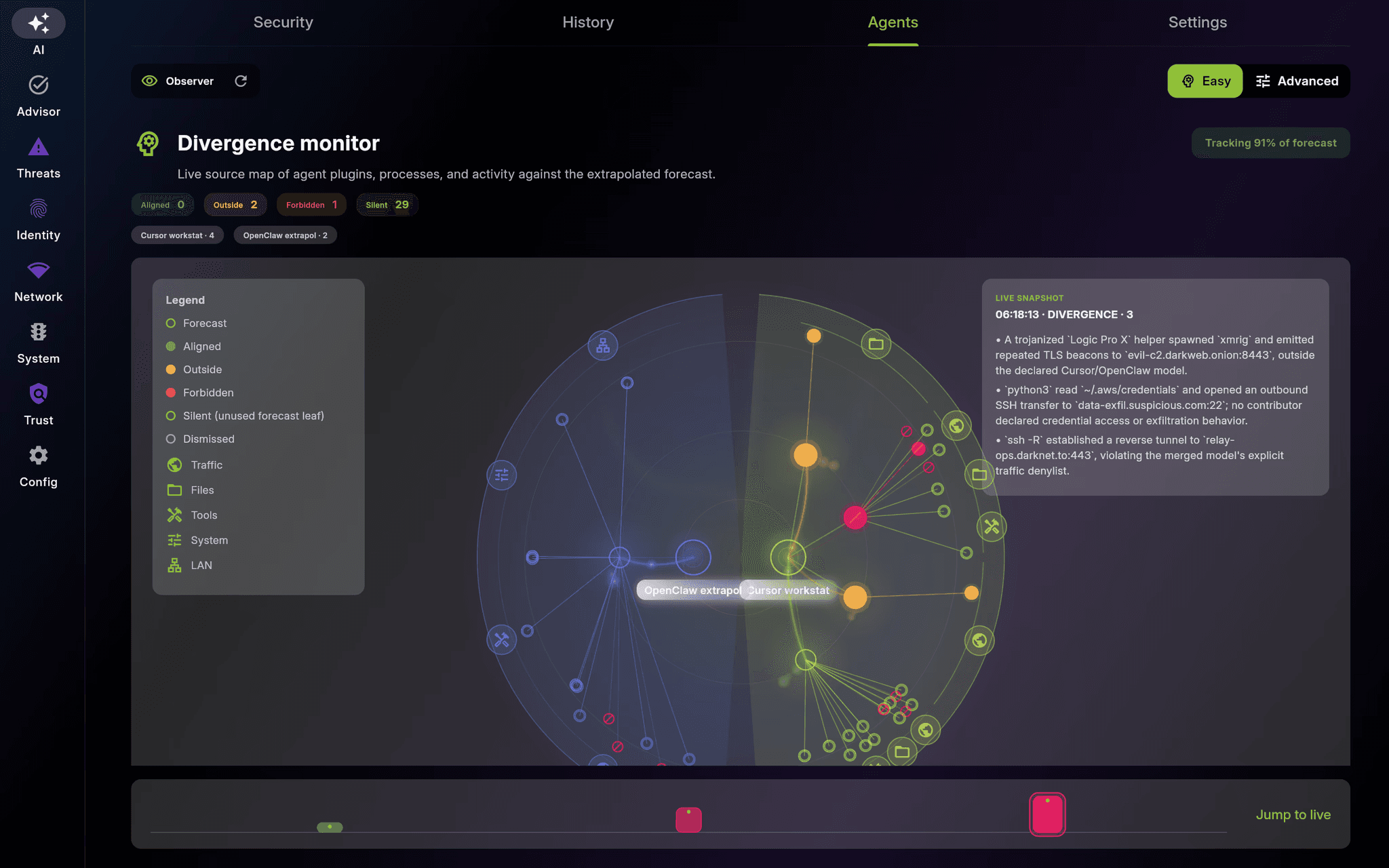
- Divergence engine: joins what the human authorized (derived from the operator’s own prompts, so there is no policy file to write), what the agent declared, and the process, filesystem, network, and posture telemetry the host actually produced
- Attack-pattern detection engine: eight deterministic check families on live telemetry — token exfiltration, skill supply chain, sandbox exploitation, credential harvest, file-system tampering, sensitive-material egress, agent control tampering, and denylist bypass
- EDAMAME Hub surfaces every agent, harness, and MCP server across the fleet, approves specific exceptions on its AI Governance page, and turns findings into conditional access; EDAMAME Portal manages identity, entitlement, and shared subscription context for rollout
This is not another interface bolted onto your code and pipelines. It is a way to bring runtime verification and attack detection into places where developers and agents already work. MCP remains a separate path for the narrow case where an agent needs to read EDAMAME core security signals inside its own workflow.
Part 1 — AI Governance: Discover, Audit, Govern
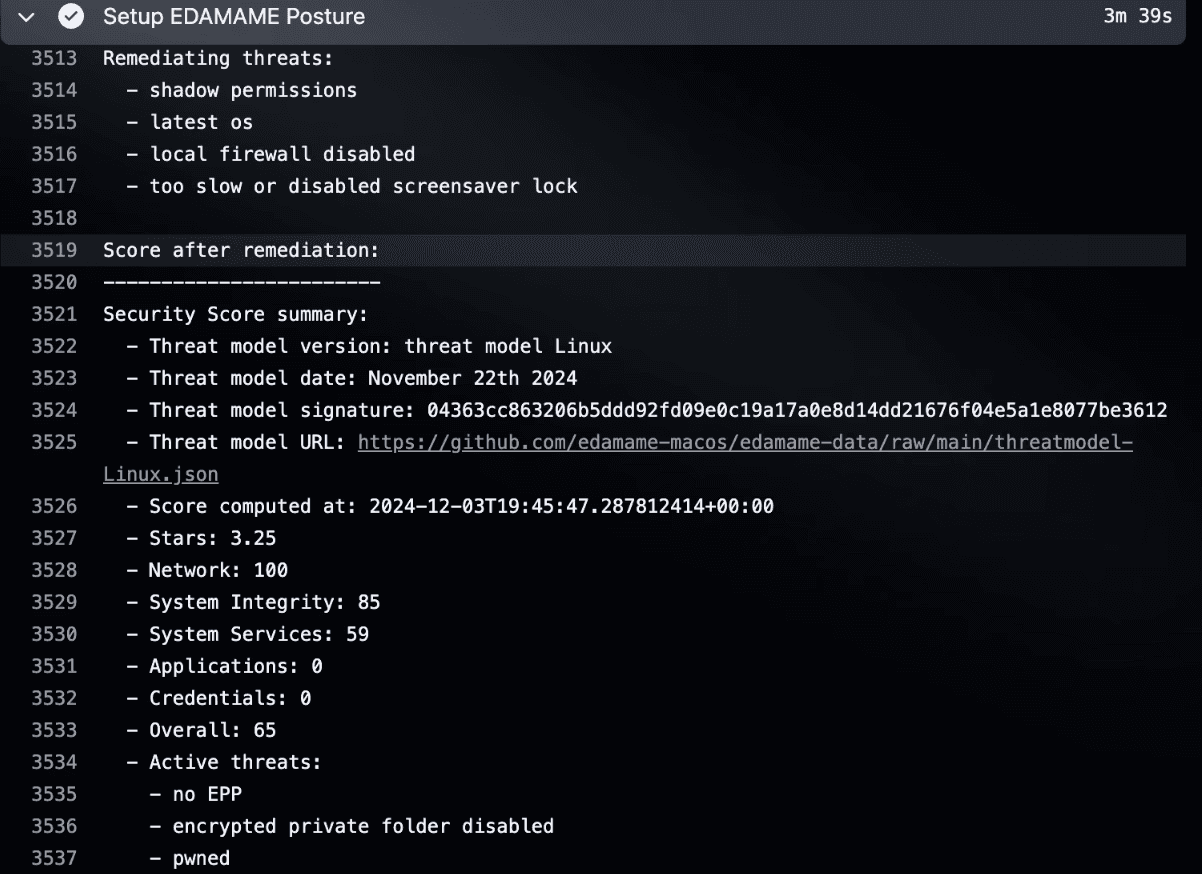
Discovery comes first, and it is deterministic: no LLM, no configuration, no plugin inside the agent. On every anchored workstation, runner, or agent host, a structural pass inventories the agentic footprint and converts what it sees into ordinary posture checks that ride the existing score and security-checks pipeline up to EDAMAME Hub.
The discovery pass surfaces:
- Agent inventory: every AI agent installed or running — Cursor, Claude Desktop, Claude Code, Codex, Hermes, OpenClaw — with observed-coverage validation, so a discovered agent whose observer is paused is itself a finding
- MCP servers and tools: the full capability surface each agent can call and how each MCP server authenticates, organized as a capability graph with trust zones to spot over-provisioned reach; an agent that exposes an unprotected MCP server is a finding
- Blast radius and harness coverage: unconfined agents sorted by danger with confinement remediation, agents running without a governance harness such as AgentField, nono, Rippletide, or Anthropic’s srt flagged fleet-wide — and a harness that is installed but not actually confining the agent reported as such
- Agent component inventory: tools, MCP servers, skills, and instruction files per agent, with MCP risk scoring and a skill supply-chain check that flags blacklisted sources
- Flight Recorder: a structural history of system, network, tool, file, and communication activity per agent — the evidence trail the security verdicts later build on
Each observation lands in EDAMAME Hub as a posture check a CISO already knows how to operate — and every AI check carries its framework references: the OWASP GenAI Agentic and LLM Top 10, MITRE ATLAS, the Agentic Trust Controls and, through them, ISO/IEC 42001 and ISO 27001 clauses, so an auditor reads pass or fail in the vocabulary of the standard being assessed. The Hub’s AI Governance page then reads the whole fleet — agent adoption, harness coverage, every MCP server with its authentication state, the conditions that recur most across devices, and what no allowlist permits — and approves exceptions for a specific agent, MCP server or condition, never by switching off the check: approve one condition on one agent and everything else that check covers keeps being flagged, and raw statuses are never rewritten. Allowlists are scoped to a domain, group, or device, can expire, start audit-only, and can restrict which agents and MCP servers may exist. Define policy on these checks and enforce Zero Trust — for example, only authorize agents wrapped in a governance harness to connect — and Hub’s posture-gated conditional access keeps non-compliant hosts off your IdP and provider allow-lists.
Part 2 — Agentic Security: Three-Plane Divergence, Attack Patterns, and Response Through Zero Trust
Scenario 1: Hidden Instruction or Prompt Injection
Without runtime correlation: the agent keeps using allowed tools, but future actions drift away from the original task.
With EDAMAME: unexpected traffic, file access, or process activity is compared against what the human authorized and what the agent declared, and surfaced as divergence — and sensitive data reaching an untrusted sink is caught by its effect, whatever text caused it.
Scenario 2: Compromised Workstation or Agent Host
Without continuous posture checks: the agent keeps operating on a device or server whose security state has degraded.
With EDAMAME: posture changes become part of the runtime picture, so risky drift can trigger escalation or access changes before trust silently persists.
Scenario 3: Tool, Plugin, or Package Poisoning
Without an independent observer: a malicious tool, plugin, or package can stay inside an allowed workflow while opening credentials, wallet files, or source material it has no business touching.
With EDAMAME: runtime verification checks whether observed behavior remained consistent with the task, while attack-pattern checks look for credential harvest, token exfiltration, tool poisoning, or other compromised runtime behavior.
These scenarios do not promise perfect prevention. They show why runtime verification and attack detection create a stronger early-warning layer than setup controls alone — and why the response can be automatic: the moment an attack pattern or a divergence verdict lands, the device score degrades, EDAMAME Hub drops the device tag, and the Zero Trust layer you already run — Netskope, your identity provider, or your network — denies that agent host the critical resources behind it, with human-in-the-loop escalation to inspect the evidence. Nothing is blocked on the workstation itself, by design: the observer stays outside the agent’s reach and the enforcement point is a system the agent never touches. A compromised agent cannot dismiss, reconfigure, or argue away findings about itself — the surface an agent can reach is read-only for observer state, dismissals are operator-only, and an agent that weakens its own sandbox or re-spells a denied command is itself a finding. The deterministic checks are held to a fail-closed release gate of 15 attack scenarios on four platforms, and the 56 curated false positives and 8 documented blind spots are published alongside.
A Shared Language for Agentic Risk: OWASP GenAI
As autonomous agents proliferate, the industry needs a common language for what can go wrong with them — and it is converging on one. The OWASP GenAI Security Project now publishes two flagship taxonomies: the Top 10 for Agentic Applications (2026, ASI01–ASI10), for systems that plan, use tools, persist memory, and coordinate with other agents, and the Top 10 for LLM Applications (2025, LLM01–LLM10). EDAMAME is built for the first list. Because it observes the agent as a principal — its goals, tools, memory, and inter-agent calls — on the host and the network, rather than inspecting model internals or filtering prompts inline, its evidence maps onto these risks structurally, not by coincidence. What follows is an honest engineering crosswalk graded against what ships today, not a certification or endorsement.
- OWASP Top 10 for Agentic Applications (2026): strong coverage on 7 of 10 risks and partial on the other 3 — the list EDAMAME fits best, because watching a principal’s real behavior on the host is exactly what these risks demand.
- OWASP Top 10 for LLM Applications (2025): 6 strong, 2 partial, 1 indirect, and 1 honestly out of scope — output factuality is a model-evaluation problem, not a runtime observer’s job, and we say so rather than pad the score.
- Agent Goal Hijack (ASI01) → the three-plane divergence engine: a hijacked objective surfaces as actions that diverge from declared intent, and hidden-prompt exfiltration lands as token exfiltration on the host.
- Unexpected Code Execution and RCE (ASI05) → deterministic sandbox-exploitation detection on host process lineage — EDAMAME's home turf, because executed code has to land on the host, where EDAMAME already watches.
- Agentic and LLM Supply Chain (ASI04, LLM03) → an agent component inventory of tools, MCP servers, skills, and instruction files, MCP risk scoring, and a skill supply-chain check that catches a poisoned dependency after it ships.
- Sensitive Information Disclosure (LLM02) → deterministic credential-harvest and token-exfiltration findings drawn from the same host telemetry.
- Excessive Agency (LLM06) → capability-graph and governance-harness coverage show what an agent can reach and whether it is fenced; external nono and Anthropic srt policy runtimes can gate tool use, while EDAMAME independently verifies what the host actually did.
- Rogue Agents (ASI10) → divergence plus reversible-first response: pause, revoke, quarantine. This rests on the invariant that makes everything above trustworthy — observer-independence. Because the observer sits outside the agent, a rogue or hijacked agent cannot silence the findings about itself.
This is an honest internal crosswalk, not an OWASP certification. Where coverage depends on a connector still rolling out — external vector-store introspection for memory poisoning, for instance — we grade it partial rather than overclaiming, and a few risks (training-time poisoning, embedding-math weaknesses, output factuality) sit outside a runtime observer’s scope by design. The evidence is also portable: every AI check carries its OWASP GenAI, MITRE ATLAS, Agentic Trust Controls, ISO/IEC 42001, and ISO 27001 references, the Compliance table filters on any of them, and findings export to the SIEM and compliance tooling a security team already runs — instead of becoming one more island of agent telemetry.
A Detection Map for Adversarial AI: MITRE ATLAS
MITRE ATLAS is a separate detection view from the OWASP risk crosswalk. EDAMAME's shipped map covers 39 runtime-observable parent techniques across 12 tactics, each with independent AML.T tags, live findings, a strong / partial / indirect grade, and the telemetry rationale behind that grade.
- Denominator: 39 parent techniques a runtime host and network observer can witness — not the complete 170+ published ATLAS matrix.
- Coverage: 16 strong, 20 partial, and 3 indirect, graded row by row rather than collapsed into a certification claim.
- Evidence: independent ATLAS technique tags, tactic grouping, live findings, and the host/network telemetry rationale for every row.
- Unknown stays Unknown: when a divergence-backed technique has no configured LLM, EDAMAME does not guess. This is an engineering coverage map, not MITRE certification or endorsement.
Approve Specific Exceptions: Audit Readiness Without a Pre-Approval Queue
Leaders need more than a promise that an agent was configured correctly. They need evidence about what was allowed, what was observed, and what happened when trust changed — and a way to say yes to the next agent, the next MCP server, and the next tool without giving up control. The control does not sit in a pre-approval queue in front of the developer. It sits in three allowlists the evidence keeps honest:
- Agents and MCP servers, in the Hub’s AI Governance allowlists: what is permitted to exist, per domain, group, or device, with an expiry — exceptions approved for a specific agent, MCP server or condition, never by switching off the check
- Egress destinations, in the Hub’s posture policies for CI/CD runners and the servers, cloud or self-hosted, that run agents: builds fail when behavior violates the allowlisted destinations
- Tools and commands, in the governance harness you already run around the agent: EDAMAME does not replace those rules; it verifies from outside that they held, and reports the day they stop holding
This matters for audit readiness — the control, the framework clause it maps to, the host evidence behind it, and its history sit in one place — but it matters even more for day-to-day decision-making. Better evidence reduces both blind trust and unnecessary panic.
Implementation and Deployment Overview
- Start with EDAMAME Security on developer workstations, aligning deployment waves with fleet visibility from EDAMAME Hub
- Use EDAMAME Posture on CI/CD runners and any server running AI agents, cloud or self-hosted
- Cursor, Claude Desktop, Claude Code, Codex, Hermes, and OpenClaw are observed automatically once the EDAMAME trust anchor is present — nothing to install into the agent
- Define posture and runtime policies that match the environment
- Use EDAMAME Hub to discover unmanaged AI-agent stacks, audit each check in your auditors’ frameworks, approve new agents and MCP servers as specific exceptions, review divergence evidence and attack-pattern findings, and keep rollout tied to identities and entitlements in EDAMAME Portal
- Expand from one surface to another without changing the underlying model
The important point is simplicity: the runtime story should stay understandable even as the deployment surface grows. Discover, audit, govern; compare what the human authorized, what the agent declared, and what the machine did; then detect attack-pattern findings from the same host telemetry.
The Strategic Advantage: Control + Speed + Trust
Organizations do not want to choose between developer speed and stronger security. They want a model that respects modern workflows while giving security teams better runtime evidence.
- Productivity from developer-first and agent-first workflows
- More trust because divergence scoring and attack detection continue after initial setup
- Lower friction than heavy admin-down or proxy-heavy approaches
- One security language across devices, runners, AI agents, and attack-pattern findings
In short: runtime verification lets teams delegate more safely because trust is checked against reality, not assumed. Attack detection makes the same host evidence useful when the problem is not agent drift, but compromised code.
Conclusion and Call to Action
AI agents have become part of the software delivery surface, and their share of the work will only grow. They deserve a security model that reflects what they actually do — read, execute, modify, connect, and decide at runtime — and one that scales to a world where most software changes pass through an agent’s hands.
The path forward is not to discard hardening, identity, or policy controls; it is to add the missing layer: discover each agent from outside itself, audit every check in the frameworks auditors already use, approve what may exist as specific exceptions, compare what the human authorized and the agent declared with observed host behavior, act when they diverge, and detect compromised behavior when code starts harvesting credentials or exfiltrating tokens. Runtime verification is how detection and response caught up with the endpoint and the SOC; the AI agent trust layer is how it catches up with the agent.
With EDAMAME, teams use Hub to inventory every AI agent, anchor the workstation or host with EDAMAME Security and EDAMAME Posture, approve the next agent as a specific exception, and keep divergence evidence plus attack-pattern findings aligned across Cursor, Claude Desktop, Claude Code, Codex, Hermes, and OpenClaw — on an evidence trail the agent cannot erase.