Zero Trust for GitHub
Zero Trust for GitHub Enterprise
Secure your source code with continuous identity, device, and contextual verification — built for modern SDLCs on GitHub.
Executive Summary
As software development becomes increasingly cloud-native and distributed, the security of source code has emerged as one of the most critical — and vulnerable — assets in any enterprise. Traditional perimeters and network-based controls no longer suffice once you adopt cloud-based workflows with remote developers, CI/CD pipelines, and SaaS integrations.
This white paper presents a robust, modern approach: applying Zero Trust principles — continuous identity, device, and context verification — directly within GitHub Enterprise access control. Leveraging the design and lessons from air-gapped on-prem systems, this approach gives teams the confidence and agility of cloud-native development without sacrificing security.
The Software Supply Chain Risk Landscape
Across today’s code and pipelines, threats don’t always target production servers. Instead, attackers aim at the development environment: developer machines, CI/CD runners, tokens, SSH keys, and API credentials. Common attack vectors include:
• Theft of personal access tokens or deployment keys
• Compromised developer laptops via malware or phishing
• Rogue or compromised CI/CD runners injecting malicious code or exfiltrating secrets
• Unmanaged contractor or BYOD devices accessing repositories
Because GitHub accepts valid tokens or keys for as long as they are not revoked, even a single leaked credential may grant an attacker full access to private repositories — no further authentication required.
These risks are amplified for regulated industries (fintech, healthcare, government) where compliance, data integrity, and intellectual property protection are mandatory.
Why Traditional Models Fall Short
VPNs and Network Overlays
VPNs or overlay solutions (e.g., Tailscale, Zero-Trust Network Access tools) offer secure tunnels and identity-based access to internal resources. Yet once a device is connected, these solutions often treat it as trusted permanently — without continuous checks on device posture, code of conduct, or the origin of each request.
This implicit trust becomes problematic if the device becomes compromised after connecting, or if credentials (tokens/keys) are stolen. Network-level trust cannot prevent misuse of valid credentials from a rogue or compromised device.
On-Prem Air-Gapped Git
Running Git servers in fully isolated, air-gapped environments has historically provided strong protection: only machines physically within the internal network or jump host could access code. But this approach doesn't scale in modern cloud-first workflows: remote teams, contractors, CI/CD, and SaaS tools all require flexible access.
Moreover, air-gapping doesn't stop threats from inside the perimeter — a compromised developer workstation inside the network still poses a risk. In practice, maintaining air-gapped infrastructure with modern development velocity becomes operationally expensive, slow, and inflexible.
Static IP Whitelists and Manual Controls
Some teams rely on static IP allowlists or manual network controls via GitHub Enterprise settings. However, modern workforces have dynamic IPs (home offices, mobile, travel), which makes allowlists brittle and hard to maintain.
Even worse: this method gives no visibility into which device is connecting — a stolen token used from an authorized IP still bypasses controls. It offers network context but no device or identity context — a critical gap when dealing with key/token-based access.
Device Trust at Login Only
Several modern identity-management solutions (SSO, Device-Trust extensions from IdPs) verify device posture only at login. But repositories like GitHub accept tokens or SSH keys for Git or API access indefinitely, bypassing the login flow — creating the "token loophole."
This design leaves a persistent security gap: after initial authentication, no further verification ensures the device or user remains compliant, fails to detect posture drift, or revokes access if the device becomes compromised.
Zero Trust Principles — Applied to GitHub Access
To bridge these gaps, we propose applying classic Zero Trust tenets directly at the source-code platform level:
• Never trust by default. Every access request must be verified — every time.
• Verify identity and device posture for every session. User identity alone is not enough. The device must meet security requirements (patches, encryption, EDR, firewall, etc.).
• Use least privilege and context-aware policies. Access should be granted only to known users on secure devices — not all authenticated users or IPs.
• Continuously enforce posture and revoke access when compliance degrades. Devices that lose compliance must immediately lose access.
• Leverage native platform controls, not overlays. Use GitHub's built-in Conditional Access and allow-listing features, updated dynamically — not custom proxies or VPN tunnels.
EDAMAME Architecture Overview
EDAMAME implements this model with a modular architecture designed to integrate seamlessly into existing development and CI/CD workflows:
• Posture Engine & Device-Agent: Monitors endpoint health (OS patches, disk encryption, firewall, EDR, integrity).
• Identity Binding Layer: Associates each device with a known enterprise identity: the user joins with a work email and a one-time PIN.
• Policy Orchestrator: Automatically updates GitHub's Conditional Access and IP allow-lists based on real-time posture and identity signals.
• CI/CD Integration: Via a lightweight CLI or GitHub Action, CI runners are verified before build or deployment, ensuring only secure machines handle code or secrets.
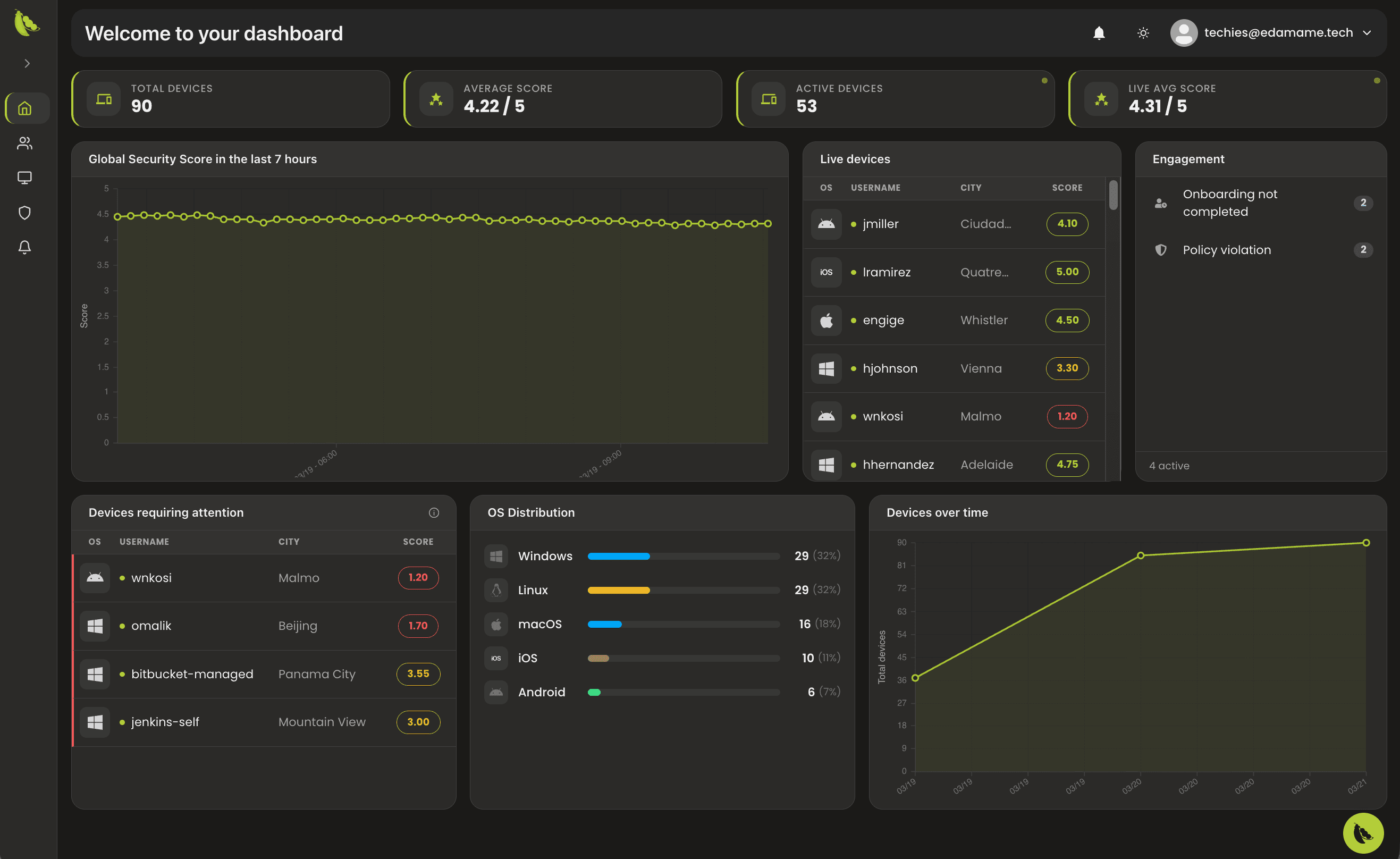
• Unified Dashboard: Central visibility across developer machines, CI/CD runners, and other endpoints for posture compliance, access history, audit logs, and alerts.
This architecture delivers the equivalent of an air-gapped environment — but for a cloud-hosted code platform, without sacrificing collaboration or speed.
Identity Binding & Continuous Device Posture Enforcement
One of the core weaknesses of token- or key-based access is that once a token is issued, GitHub trusts it indefinitely — no further checks.
With EDAMAME:
• Every device is first associated with a corporate identity via SSO/IdP.
• Access to GitHub only proceeds if the device meets the defined security posture.
• If a device later becomes non-compliant (e.g., security patch missing, EDR disabled), EDAMAME revokes its allow-list entry — GitHub connectivity is blocked immediately.
This ensures that a stolen token or compromised device becomes useless — the platform enforces both who you are and where you are connecting from at the time of access.
Real-World Attack Scenarios & How EDAMAME Prevents Them
Scenario 1: Stolen Personal Access Token
Without continuous checks: valid token → full access.
With EDAMAME: device not recognized or compliant → access denied.
Scenario 2: Malware-Infected Developer Laptop
Without continuous posture enforcement: once logged in, the laptop can push or clone repositories.
With EDAMAME: if posture degrades or a threat is detected, the device is removed from allow-list; GitHub operations blocked.
Scenario 3: Compromised CI/CD Runner or Build Container
Without verification: runner pulls secrets or code and executes malicious payloads.
With EDAMAME: runner must pass posture and integrity checks before any build or secret access is allowed — malicious runners are blocked.
These protections dramatically reduce risk from credential theft, insider threats, and supply-chain attacks.
Secure Migration from On-Prem Git to GitHub Cloud
For organizations migrating from on-prem or air-gapped Git servers, EDAMAME offers a path that preserves — and enhances — security.
• Maintain identity and device posture binding across both on-prem and cloud repositories.
• Apply the same security baseline to laptops, CI runners, contractors, and external collaborators.
• Enable hybrid operations: some code remains on-prem while new projects live in GitHub — all under a single, unified trust policy.
• As you decommission legacy servers, transition seamlessly without introducing security gaps.
Compliance, Audit Readiness & Regulatory Alignment
Modern regulations and standards — including SOC 2, ISO 27001, fintech-specific frameworks (e.g. DORA), and supply-chain security requirements — increasingly emphasize access control, endpoint security, audit trails, and identity verification. EDAMAME provides:
• Continuous enforcement of security posture for all endpoints
• Comprehensive logs and audit trails (who, when, from what device)
• Dynamic revocation and real-time policy enforcement — powerful evidence for auditors or regulators
This unified approach simplifies compliance while elevating actual security — no more checkbox-based "compliance illusions."
Implementation & Deployment Overview
• Onboard developer devices via lightweight agent (macOS, Windows, Linux, mobile).
• Configure posture policies (patch level, encryption, EDR, firewall, integrity).
• Integrate with enterprise SSO/IdP for identity binding.
• Install EDAMAME CLI or GitHub Action in CI/CD pipelines.
• Define Conditional Access policies in GitHub Enterprise; EDAMAME automatically manages dynamic allow-lists.
• Use the centralized dashboard for visibility, reporting, device inventory, audit logs, and compliance status.
The result: deployment in hours, not weeks — minimal disruption, maximum security.
The Strategic Advantage: Security + Speed + Trust
By applying Zero Trust at the source — at the level of GitHub interactions — EDAMAME gives enterprises:
• The agility and collaboration power of cloud workflows
• The protection and assurance of an air-gapped system
• Continuous enforcement without burdening developers or slowing down pipelines
• A unified, auditable security posture across your code and pipelines
In short: you no longer have to choose between innovation and security.
Conclusion & Call to Action
As attackers shift focus from production servers to development environments, it's critical to evolve how we secure code. The traditional perimeter is gone; identity-only solutions are insufficient; tokens alone are a liability.
Adopting a Zero Trust model — continuous verification of user identity, device health, and request context — is the only way to truly protect your repositories, your secrets, and your intellectual property.
With EDAMAME, you get a proven solution that enforces these principles directly on GitHub Enterprise — granting access only to verified users on secure devices, at every request.